Operando measurements of hazardous chemical reactions
Many Power-to-X applications involve chemical and electrochemical reactions that are difficult to study because the materials involved are reactive, air-sensitive, flammable, explosive, or otherwise hazardous. This includes important areas such as catalysis, hydrogen storage, liquid organic hydrogen carriers, and battery-related chemistry. In many cases, these materials must be prepared outside the instrument in protected environments, which makes experiments slower, more complex, and less flexible.
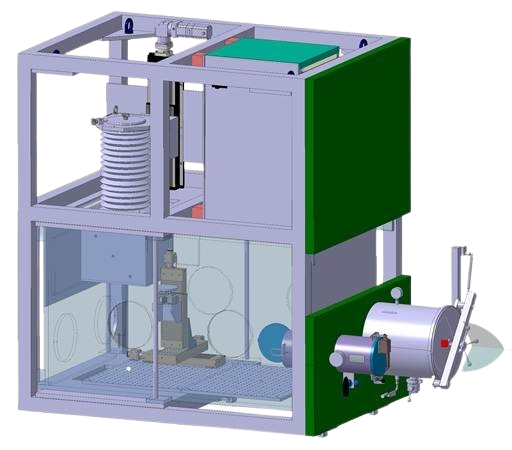
ACTNXT aims to improve this situation by developing new neutron-compatible instrumentation for the safe handling and study of reactive and hazardous materials under controlled conditions. A central element is the development of an in-line glovebox concept for neutron experiments, allowing samples to be prepared, exchanged, and investigated directly at the beamline without unnecessary exposure to air or contamination. This can make experiments both safer and more efficient, while also improving data quality.
Neutrons are particularly well suited to this type of research because they can penetrate thick reactor walls and containment materials more easily than many other analytical methods. This makes them highly valuable for studying chemical reactions under realistic operating conditions, even when these involve demanding sample environments or enclosed systems. ACTNXT will also develop a conceptual design for a future neutron imaging beamline dedicated to chemical experiments, including gas handling, electrochemical control, product analysis, and the necessary safety infrastructure.
This focus area is important because many emerging PtX technologies depend on research environments that can handle difficult chemistry safely and reliably. By expanding Europe’s ability to study such systems, ACTNXT will help open new areas of research and create stronger links between advanced science, industrial innovation, and the practical needs of the green transition.
The figure shows a preliminary drawing of a neutron imaging beam line end stage with in-line glove box. The glove box will contain the sample stages and required chemical infrastructure. For simplicity, the sample positioning stages inside the glovebox and the chemical infrastructure required for the experiments are not shown.