About ACTNXT
The mission of ACTNXT
ACTNXT is a European project designed to improve how research infrastructures support the development of Power-to-X (PtX) technologies. PtX includes technologies that convert renewable electricity into hydrogen, fuels, chemicals, and other energy carriers that are expected to play a major role in a CO22-neutral society.
Although neutron and synchrotron x-ray facilities offer unique ways to study materials and components in real operating conditions, their wider use in PtX research is currently limited by a lack of dedicated equipment and workflows. ACTNXT aims to overcome this by developing new instrumentation and methods in four focus areas:
- Operando measurements of processes and flow inside PtX components
The project will develop advanced test benches for fuel cells and electrolysers, making it easier to study what happens inside these systems while they are running. - Materials behaviour under hydrogen exposure
The project will create specialised sample environments for studying how hydrogen affects materials, including challenges such as hydrogen embrittlement and high-temperature hydrogen attack. - Reliable, high-throughput investigation of novel materials
The project will develop faster experimental workflows, including automated data handling and AI-supported analysis, to help researchers screen and optimise materials more efficiently. - Operando measurements of hazardous chemical reactions
The project will design new neutron-compatible environments, including an in-line glovebox concept, to enable safe studies of reactive and hazardous materials.
In addition, the project will build a common knowledge platform to help research infrastructures, research and technology organisations, universities, and industry make better use of the new capabilities. This includes guidance, safety practices, and AI tools to improve experiment planning and data analysis.
Overall, ACTNXT aims to expand the role of European research infrastructures in PtX research, support stronger collaboration between science and industry, and help accelerate the development of cleaner, safer, and more efficient energy technologies.
Focus Areas
Operando measurements of processes and flow inside PtX components
Materials behaviour under hydrogen exposure
Reliable, high-throughput investigation of novel materials
Operando measurements of hazardous chemical reactions
Work packages
WP1: Project Management
WP1 ensures that the ACTNXT project runs effectively across the full consortium. It covers overall coordination, communication with the European Commission, financial and administrative management, risk monitoring, quality assurance, data management, and intellectual property issues. It also supports smooth collaboration between partners and work packages, so that the project progresses according to plan and that any challenges are identified and addressed early.
In addition, WP1 is responsible for creating and maintaining the project’s data management and risk management plans, ensuring compliance with open science principles, FAIR data practices, and relevant ethical and legal requirements. It also includes regular dialogue with an Industrial Advisory Board to help ensure that the project remains relevant to industrial needs and opportunities.
WP2: Operando Multi-Modal Studies of PtX Components
WP2 focuses on developing advanced test benches for studying fuel cells and electrolysers while they are operating. These test benches are essential for allowing neutron and synchrotron instruments to analyse what happens inside PtX components under realistic conditions. The work package aims to create equipment that is robust, safe, portable, and compatible with a wide range of research infrastructures and instrument types.
The work includes identifying the needs of users in research and industry, mapping the capabilities of current research infrastructures, defining technical specifications, designing and building prototype test benches, and validating them through real experiments. The long-term goal is to make these tools available as an integrated part of European research infrastructure services, so that more users can perform advanced operando studies without having to bring and adapt highly specialised equipment themselves.
WP3: Materials under Hydrogen Exposure
WP3 develops new instrumentation for studying how materials behave when exposed to hydrogen under realistic conditions of pressure, temperature, and mechanical stress. This is a critical area for PtX technologies, because hydrogen can weaken materials and cause problems such as hydrogen embrittlement, high-temperature hydrogen attack, and unwanted permeability.
To address this, WP3 will develop specialised sample environments for both neutron and synchrotron experiments. These will allow researchers to study changes in the bulk of materials as well as near the surface, using complementary methods. The work includes gathering requirements from stakeholders, designing and building prototype cells, commissioning them at relevant facilities, and carrying out demonstration experiments. The results are intended to improve Europe’s ability to develop safer and more reliable materials for hydrogen-based technologies.
WP4: High-Throughput Workflows for Rapid Characterisation of Materials for the Hydrogen Economy
WP4 is dedicated to making materials characterisation much faster and more efficient. PtX technologies depend on many new materials, but current investigation methods at large-scale facilities are often too slow and too manual. WP4 addresses this by developing high-throughput workflows that combine automated sample handling, standardised preparation methods, faster data processing, and AI-supported analysis.
The work package focuses on several techniques widely used in PtX materials research, including x-ray diffraction, small-angle x-ray scattering, x-ray absorption spectroscopy, and neutron imaging. It includes the definition of concrete industrial and research use cases, the development of hardware for rapid measurements, the creation of automated data reduction pipelines, and the validation of complete workflows on real samples. By doing so, WP4 aims to speed up materials optimisation and strengthen data-driven and AI-assisted materials development in Europe.
WP5: Neutron Instrumentation for Analysis of Reactive and Hazardous Materials during Chemical and Electrochemical Reactions
WP5 addresses a major challenge in PtX research: many relevant materials and reactions are difficult to study because they are reactive, air-sensitive, flammable, explosive, or otherwise hazardous. Existing approaches often require samples to be prepared outside the instrument and transferred under strict conditions, which is time-consuming and limits flexibility.
To overcome this, WP5 will develop new neutron-compatible instrumentation for safe and efficient studies of hazardous and reactive systems. A key element is the design and implementation of an in-line glovebox for neutron experiments, allowing controlled sample preparation, exchange, and analysis directly at the beamline. WP5 also includes the conceptual design of a future neutron imaging beamline dedicated to chemical experiments, with integrated gas handling, electrochemical control, product analysis, and safety infrastructure. This work package is expected to expand the range of PtX-related systems that can be studied at research infrastructures.
WP6: Common Knowledge Platform
WP6 creates the shared framework that connects the technical work packages and helps make their results usable beyond the project itself. It focuses on practical tools, methods, and guidance that can support future PtX experiments and further development at European research infrastructures.
This includes developing safety guidelines for hydrogen-related experiments, creating digital tools and AI-supported models for experiment planning and sample environment design, and exploring access models better suited to the needs of PtX research and industrial users. WP6 will also produce an inspirational catalogue of PtX-related instrumentation possibilities, challenges, and case examples. In this way, the work package helps turn the project’s technical results into a broader resource for research infrastructures, research organisations, and industry.
WP7: Communication and Outreach
WP7 ensures that ACTNXT’s results are visible, understandable, and useful to the right audiences. It covers dissemination, communication, stakeholder engagement, clustering with other European projects, and planning for the future exploitation of project results.
This includes developing the project’s communication and dissemination plan, maintaining the project website and digital channels, producing outreach materials, organising workshops and beamline visits, and connecting ACTNXT to relevant European initiatives, user communities, and industrial networks. WP7 also supports knowledge management and exploitation planning, helping identify how project results can be taken up by research infrastructures, research organisations, and industry after the project ends. In this way, the work package helps maximise the long-term impact of ACTNXT.
Partners
















Focus Areas
Operando multi modal studies of PtX component
This focus area is dedicated to the design, development, and validation of advanced test benches for operando, multi-modal studies of fuel cell and electrolyzer components at major research infrastructures. The aim is to create robust, portable, and user-friendly devices that meet both current and future scientific needs, supporting in-situ and accelerated ageing studies relevant to industry. Test benches will be engineered for compatibility with a wide range of neutron and X-ray instruments (ILL, PSI, ESRF), ensuring seamless integration and safe operation. Specifications are defined in close collaboration with RTOs and industry to maximize relevance and adaptability, including the use of off-the-shelf components and interfaces for rapid diagnostics. Cells provided by CEA and TNO will be used to validate the systems, and all technical documentation will be distributed to partners. Training will be provided to ensure effective operation and maintenance, supporting broad adoption and long-term scientific impact.
As an example of operando study, the video shows the water distribution inside a proton exchange membrane fuel cell stack.
Materials under hydrogen exposure
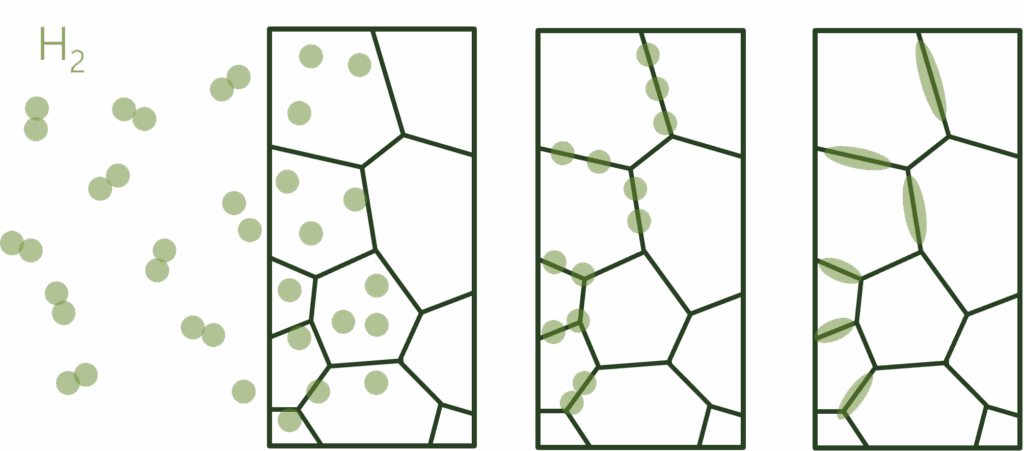
This focus area aims to develop advanced instrumentation for in-situ studies of materials exposed to hydrogen under varying pressures and temperatures. The goal is to address challenges such as hydrogen embrittlement and permeability by enabling comprehensive chemical and structural analysis from atomic to macroscopic scales. Custom high-pressure cells will be designed for use with both synchrotron and neutron techniques, supporting detailed investigations of bulk and surface properties. Techniques like grazing-incidence small-angle X-ray scattering and photoelectron spectroscopy at CERIC, as well as neutron imaging at PSI and ESS, will allow precise localization of changes in materials. The instrumentation will be compatible with a range of facilities and adaptable to high-energy X-ray techniques at ESRF. Throughout the project, stakeholders will provide requirements, and demonstration experiments will ensure broad applicability. All results and technical specifications will be shared openly to support wide adoption by the research and industrial community.
The figure shows an Illustration of the HE process
High throughput workflows for rapid characterization of materials for hydrogen economy
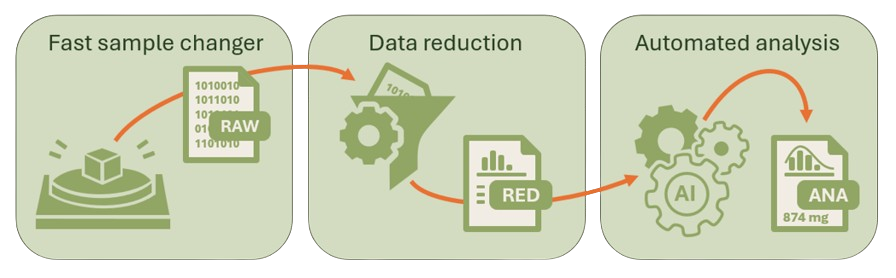
This focus area targets the development of integrated instrumentation and data pipelines for rapid characterization of materials central to the hydrogen economy. By combining ex-situ, in-situ, and operando approaches, the goal is to enable high-throughput, AI-assisted workflows for accelerated discovery and stress testing of catalysts, electrolytes, and electrode assemblies. Key techniques include X-ray diffraction, small angle X-ray scattering, X-ray absorption spectroscopy, and neutron imaging, implemented at leading research facilities (ESRF, PSI, CERIC). The workflows will feature automated sample handling, standardized preparation routines, and advanced data processing and analysis, ensuring interoperability across instruments. Use cases from both research and industry will guide the process, ensuring relevance and practical impact. The resulting workflows will significantly speed up materials development, with all protocols and tools made available for widespread adoption.
Neutron instrumentation for analysis of reactive and hazardous materials for (electro-)chemical reactions
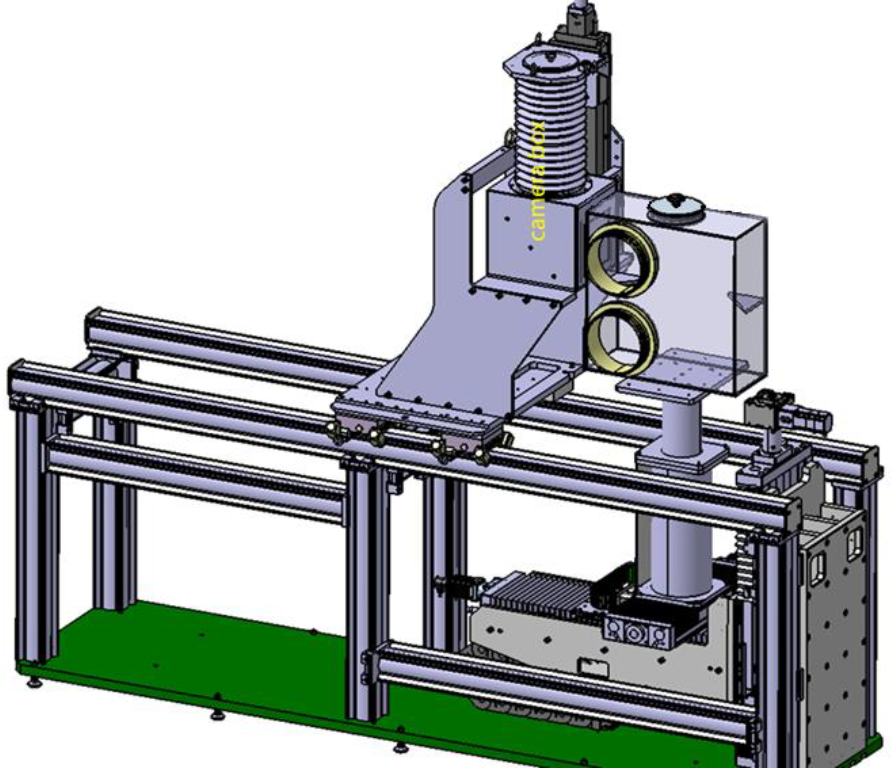
This focus area is dedicated to developing advanced instrumentation for neutron imaging analysis of reactive and hazardous materials, extending applications beyond fuel cells and electrolyzers to include catalyst design, hydrogenation reactors, storage materials, and liquid organic hydrogen carriers. The first phase targets enhancing the capabilities of current neutron imaging beamlines at PSI, with a strong emphasis on the design and integration of in-line gloveboxes for safe handling of sensitive substances. Building on user experience, these gloveboxes will provide clean, controlled environments for complex experiments. The long-term objective is to conceptualize a dedicated chemical neutron imaging beamline equipped for advanced chemical and electrochemical studies, with robust safety features. The results and designs will be made publicly available to maximize impact and facilitate broad adoption within the research community.
The figure shows a preliminary drawing of a neutron imaging beam line end stage with in-line glove box. The glove box will contain the sample stages and required chemical infrastructure. For simplicity, the sample positioning stages inside the glovebox and the chemical infrastructure required for the experiments are not shown.
Project Public Deliverables
This section provides access to the public deliverables of this research project. The deliverables encompass project components including governance structures, methodological frameworks, risk assessment protocols, and dissemination strategies.