Materials behaviour under hydrogen exposure
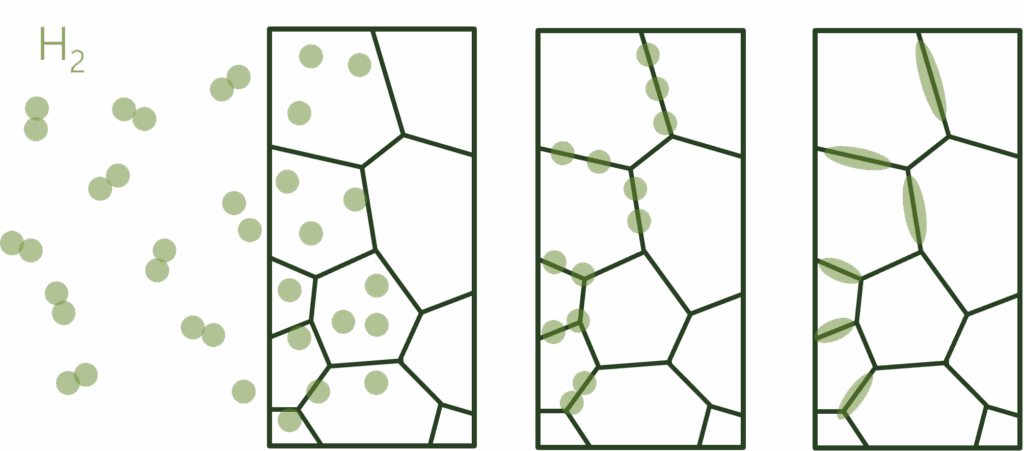
Hydrogen can damage materials in ways that are difficult to predict and even harder to monitor in real time. This is a major issue for hydrogen storage, transport, and industrial use. Problems such as hydrogen embrittlement, high-temperature hydrogen attack, and hydrogen permeability can weaken metals and other materials, sometimes leading to critical failure.
Most existing studies are carried out in laboratories and often rely on post-mortem analysis after the material has already failed. While useful, that approach does not fully capture what actually happens during hydrogen exposure. ACTNXT therefore aims to develop new sample environments and measurement setups that allow materials to be studied in situ, while they are exposed to hydrogen, pressure, temperature, and mechanical stress.
The project plans to combine several advanced techniques. Synchrotron methods can help investigate near-surface chemistry and structural changes, while neutron methods are especially valuable for tracking hydrogen inside bulk materials, since neutrons are highly sensitive to hydrogen and can penetrate deeply into metals. This combination can provide a much more complete picture of how materials behave under realistic hydrogen conditions. The instrumentation will be designed to be compatible with a range of facilities and, where relevant, adaptable to high-energy x-ray techniques at ESRF.
Throughout the project, stakeholders will help define requirements, and demonstration experiments will be used to ensure broad applicability. Results and technical specifications will be shared openly to support wide uptake across the research and industrial communities.
The figure shows an Illustration of the HE process