Reliable, high-throughput investigation of novel materials
The development of Power-to-X technologies depends on a wide range of new materials, including catalysts, membranes, coatings, and hydrogen-resistant structural materials. Finding the right materials is a major scientific and industrial challenge, because researchers often need to test large numbers of samples across many different conditions. Today, this process is still too slow, with many measurements carried out one sample at a time and with significant manual effort in both sample handling and data analysis.
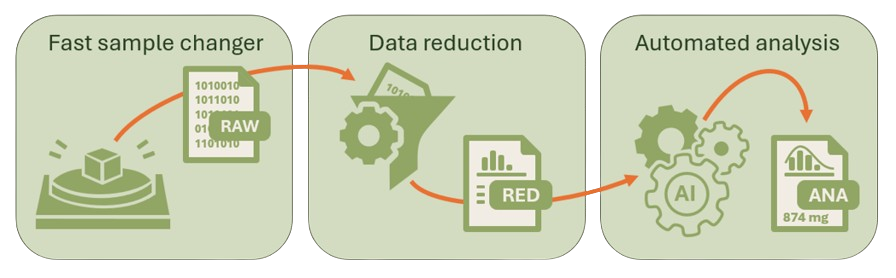
ACTNXT aims to address this bottleneck by developing high-throughput workflows that make materials characterisation faster, more standardised, and more useful for large-scale innovation. This includes new hardware for rapid sample handling, automated data reduction pipelines, and AI-supported data analysis. The project focuses on several techniques regularly used for PtX materials research, including x-ray diffraction, small-angle x-ray scattering, x-ray absorption spectroscopy, and neutron imaging.
These developments are important because they can significantly increase the number of samples that can be studied in a given amount of time, while also improving data quality and consistency. This is particularly valuable in PtX research, where material optimisation often requires the exploration of large design spaces — for example when reducing the use of scarce raw materials or improving long-term stability under demanding operating conditions.
In practical terms, ACTNXT will help Europe’s research infrastructures support faster and more data-driven materials development. By generating larger and more standardised datasets, the project can also strengthen the use of artificial intelligence in materials discovery and help shorten the path from early research to industrial application.